
A universal phone charger sounds like the simple answer to a drawer full of cables, but the label covers several very different products. A universal phone charger could mean a USB-C wall adapter, a kit with several cable tips, a wireless charging station, or a travel charger with multiple ports. The right choice depends less on the word universal and more on the devices you actually carry.
My basic advice is simple: buy for how you live, not for how it looks on the spec sheet. If you commute with one phone and wireless earbuds, a compact two-port charger is probably smarter than a large desktop station. If you travel with a phone, tablet, laptop, watch, and power bank, port selection and charging capacity matter much more.
What universal really means
There is no single connector that charges every modern device. Most current Android phones, iPads, laptops, earbuds, and power banks use USB-C. Many older iPhones and accessories still use Lightning, while newer iPhones use USB-C. Apple Watch models also require their own magnetic charging puck, even when that puck ends in USB-C.
That means a universal phone charger usually refers to the power source, not one magical cable. A USB-C charger can support several devices when you use the correct cable for each one. Some kits include USB-C, Lightning, and Micro-USB connectors, but these bundled cables can vary in build quality.
Read the package carefully. A charger with three USB-C ports gives you flexibility, but it does not automatically include cables. A multi-tip cable gives you connector coverage, but it may charge multiple devices slowly when several ends are being used at once. Those are useful distinctions before you spend $20 to $100.
Choose the charger around your daily carry
Start by listing what leaves the house with you. For a phone, earbuds, and smartwatch, look for at least two outputs and a small footprint. A 30-watt USB-C Power Delivery charger is enough for most phones and many tablets. Brands such as Anker, Belkin, UGREEN, and Spigen offer compact models in this range.
For a phone and laptop, step up to 65 watts or more. A charger rated at 65 watts can usually handle a phone while delivering useful power to a lightweight MacBook Air, Chromebook, or Windows ultrabook. If you regularly charge a larger laptop, a 100-watt model gives you more breathing room, especially when another device is connected.
This is where a universal phone charger can either simplify your bag or create frustration. A tiny 20-watt brick is convenient, but it is not the right tool for a laptop. A four-port desktop unit is powerful, but it is unnecessary if you only charge one phone overnight. Match the hardware to the busiest part of your routine.

Port count is not the same as charging speed
Manufacturers often advertise the combined output of a charger, not the power available from each port at the same time. For example, a 100-watt charger might provide 65 watts from its main USB-C port and divide the remaining power among other connections. That is normal, but it is easy to miss in a quick online listing.
Look for USB-C PD support when fast charging matters. PD is a common charging standard that lets a compatible charger and device negotiate an appropriate power level. Qualcomm Quick Charge can also appear on Android-focused products, although USB-C PD is generally the more useful feature for a mixed-device household.
If you use an iPhone, confirm that the cable supports the charging speed you want. A USB-C wall adapter does not make a Lightning cable a fast-charging cable. The same principle applies to older Micro-USB accessories: they can work with an adapter, but the device itself may remain limited to slower charging.
A universal phone charger is most useful when its ports deliver predictable power under normal use. Look for output details in the technical specifications rather than relying on phrases such as turbo, ultra, or rapid. Clear wattage information is more valuable than flashy packaging.
Wall charger, travel charger, or charging station?
A compact wall charger is the best everyday option for most people. It takes little space, works in a hotel outlet, and can move between a home office and a bedside table. GaN chargers are popular because gallium nitride allows many models to stay relatively small while supporting higher power levels.
A travel charger makes sense when you pack several devices. A three-port model can replace separate phone, tablet, and laptop bricks, reducing both weight and cable clutter. Choose folding prongs and a sturdy casing if the charger will live in a backpack. A soft pouch is also worthwhile because loose cables eventually collect dust and bend at the connector.
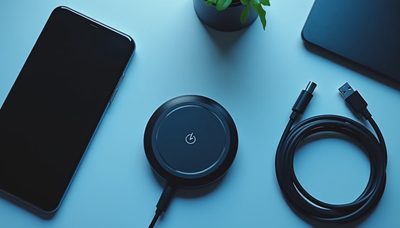
A charging station is better for a fixed location. It can keep a phone, earbuds, and watch organized on a nightstand, but it is less flexible when you travel. Wireless stations can also charge more slowly and generate more heat than a wired connection. They are convenient, not automatically faster.
Cable quality still matters
People often blame the wall adapter when the cable is the real problem. Frayed jackets, loose connectors, and very thin bargain cables can cause intermittent charging or reduced performance. For USB-C, check whether a cable is rated for the power you need. Laptop charging can require a 60-watt or 100-watt cable, while a basic phone cable may not support those levels.
For iPhone users with Lightning devices, look for MFi-certified accessories from reputable brands. For USB-C devices, a cable with clear power and data ratings is a better choice than one described only as heavy duty. Keep one short cable at your desk, one in your travel bag, and one near the bed instead of constantly moving a single cable around.
A universal phone charger paired with the wrong cable can feel unreliable even when the adapter is perfectly good. Spending an extra $8 to $20 on a durable cable is often more useful than replacing the charger.

Safety features are worth paying for
A credible charger should include basic protections against overcurrent, overvoltage, overheating, and short circuits. Buy from an established brand or retailer, and avoid suspiciously cheap chargers with vague specifications. A $7 listing promising 150 watts is not a bargain if it provides no clear safety information or warranty.
Heat deserves practical attention. A charger can become warm during normal use, particularly when powering a laptop, but it should not smell like hot plastic, discolor a wall outlet, or become too hot to handle. Keep ventilation around larger charging hubs, and do not cover them with clothing or bedding.
Wireless chargers also need correct alignment. A thick case, metal accessory, or misplaced phone can interrupt charging and create extra heat. If your phone repeatedly starts and stops, test it without the case before assuming the charger has failed.
A simple buying checklist
Before ordering, answer five questions. How many devices need power at the same time? Does any device require USB-C PD? Do you need at least 65 watts for a laptop? Will the charger stay home or travel every week? Which cables do your devices actually use?
For one phone and earbuds, choose a two-port 30-watt charger and two dependable cables. For a phone, tablet, and laptop, look at a 65-watt or 100-watt multi-port model. For a family sharing one outlet, prioritize four ports and published power sharing details. For a bedside table, a wireless station is convenient if you accept slower charging and limited portability.
The best universal phone charger is the one that removes a real annoyance without adding another accessory to manage. Compare the total setup cost, including cables, rather than judging the wall adapter alone.
Final buying advice
A universal phone charger is a useful category when you treat it as a flexible power system instead of a magic all-in-one cable. Start with your devices, identify the highest power requirement, and then choose the smallest charger that can handle that workload safely.
For most people, that means a reputable USB-C PD charger between 30 and 65 watts, plus the correct cables for each device. Frequent travelers should consider a compact multi-port GaN model, while home users may prefer a charging station. Skip features your routine never stresses. The cleanest setup is usually the one you can understand, pack, and use without thinking.